Most Theory of Change work in forest investment weakens credibility. Here’s how to avoid it.
Impact investment has a communication AND delivery problem.
In my article Are you in the impact mafia, I discuss an article criticizing impact investment. One of its critiques is on the Theory of Change, where the author describes it as “a diagram with arrows that proves we’ve thought about this for at least 15 minutes”.
If this is how your Theory of Change is being used in your impact capital raise, it is not a tool to advance your strategy, it is diluting your credibility.
It’s not helping you to deliver impact alongside financial returns, its creating confusion and may paint your impact strategy as a distraction.
In this week’s article I discuss what not to do with your Theory of Change, if you are looking to raise capital from impact investors AND create more value from your forest investments.
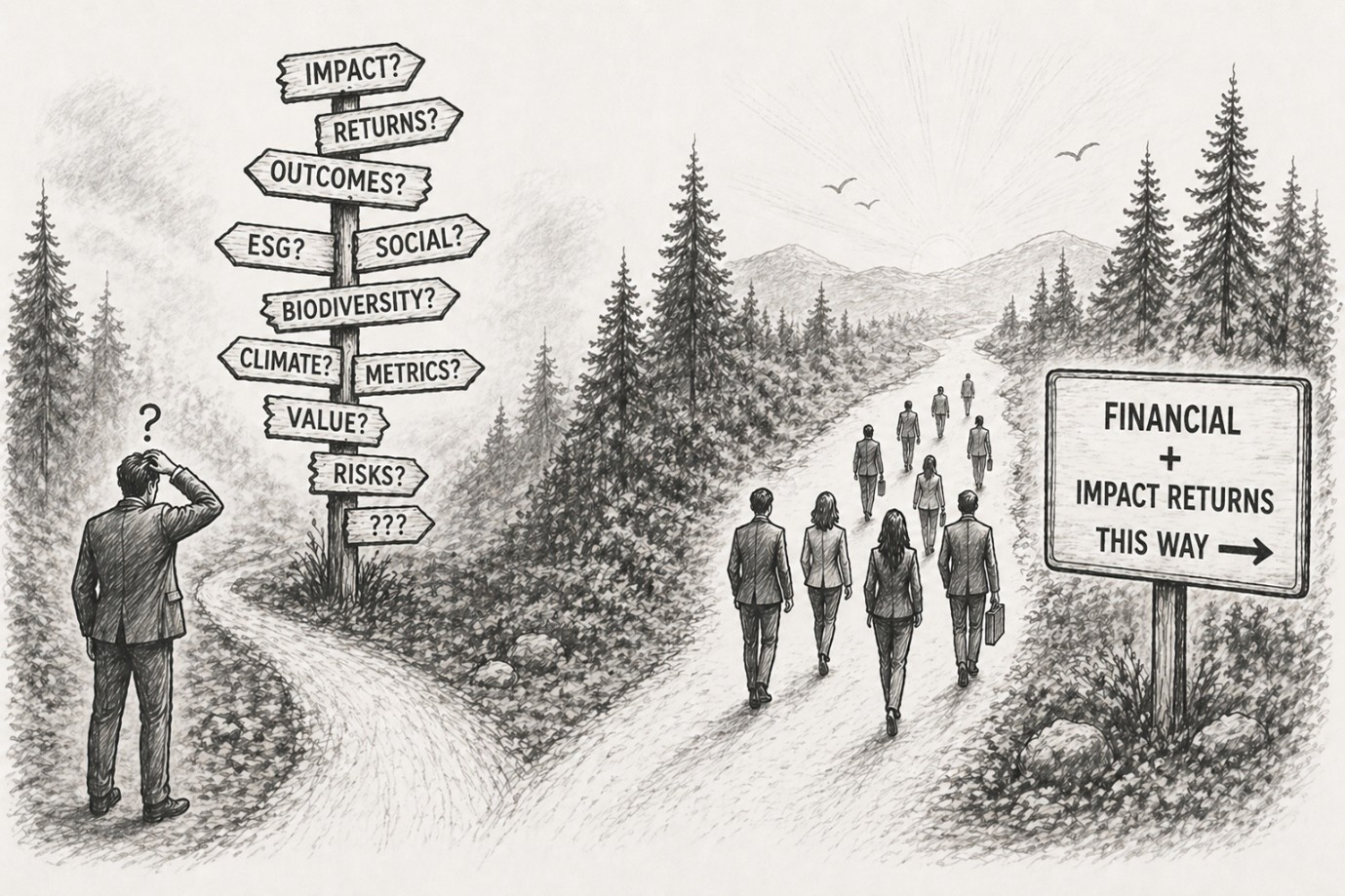
5 Things NOT TO DO with your Theory of Change
From my work with different firms, I’ve seen pitfalls repeated with applying a Theory of Change. Instead of being an important strategy alignment, communication and implementation tool, the Theory of Change becomes an expensive slide.
Here are the pitfalls I’ve seen – If you are using a Theory of Change for your forest investment strategy, don’t make these 5 mistakes:
1.Outsource it
Externalsupport can help but handing it over entirely is risky. If someone else creates your Theory of Change, they’ll probably miss the mark of your differentiation and your team often cannot integrate it, explain it, or use it for implementation.
2. Let one person own it
If the Sustainability, ESG or Impact lead develops it alone, impact remains siloed from investment strategy. That means missed opportunities, poor alignment and unnecessary implementation risk.
3. Treat it as one-and-done
A Theory of Change should evolve. It needs testing, challenge, and refinement as your strategy develops. If it stays static, it quickly stops reflecting reality and credibility.
4. Fill it with jargon
Your Theory of Change is a communication tool first, and implementation tool second. It must be understood by investment teams, operations, leadership, investors, and external stakeholders. If only specialists understand it, it will be effectively useless.
5. Focus only on impact objectives
This is one of the most common mistakes. In an investment context, your Theory of Change must integrate both financial and impact objectives. Through its development, you must consider where these objectives reinforce each other and where trade-offs exist. The result will be a value creation strategy that investors will trust.
Your Theory of Change Blueprint
If you are building a new forest investment strategy and want to avoid these mistakes, I’m happy to share this Theory of Change webinar, where I describe what it is, why you need one, and how you build it. If you want to jump right into the “how-to”, fast forward through to 18:32 on the video.
If you want to see how I help asset managers with the Theory of Change (and not create it for them), please reach out and set up a call. I’d be happy to discuss where your strategy sits today and the most practical steps to move it forward.
Did you like this article? Sign up now for the ForestLink’s newsletter, where you’ll receive technical advice, reflections, and best-practice guidance to support you with your forest-linked investment strategy or business straight to your inbox.