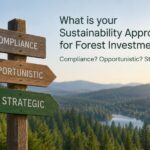
Are you scratching the surface when you think about ESG in your forest investment approach, or are you fully covering risk and opportunity?
Sustainability, Impact, ESG – if search engine optimization was still a thing, my articles would probably be top of the list when coupled with forest investment.
I have a tendency to beat this drum – loud and often.
Why?
Because I still get questions from clients and peers on how they should even be defining sustainability.
I’m not here today to drone on about definitions, but to encourage you to reflect on your approach to ESG risk, because this is often only partially addressed in forest investment.
In an ESG-phobic investment environment – its less important we talk about the acronym and more important we talk about it’s meaning. The ESG-naysayers are concerned that investment decisions are going to be based on environmental, social and governance criteria, not on solid financial criteria. The thing with forest investment, is that in many cases, ESG criteria = financial criteria. Listen to this episode from the vault, where I speak with Steve Novakovic from CAIA on forest investment and he tackles this debate head on.
What I commonly see is that material ESG risks are well managed for:
- If your assets are in fire-prone landscapes, you’re going to have state of the art fire prevention, detection and suppression measures in place,
- If your assets are associated with overlapping land-use rights, you are going to ensure that you have the legal instruments in place to protect your rights,
- If the government requires you to have a harvesting permit in place to extract timber, you are going to ensure these are up-to-date in time for planned harvests.
What gets missed? Indirect material ESG risks that at first glance are not seen as a threat to the financial viability of your forest assets. In other words, these are risks to environmental, social or governance conditions from your investment activities, without direct financial impact:
- Forestry activities with potential for downstream water impacts,
- Stakeholder engagement when operating on owned, free and clear land title,
- In-house governance that only address material ESG issues.
So what are the concerns with only considering direct material ESG risks?
For one, indirect risks have a way of turning into financially material risks – think of potential lawsuits or reputational risk – if said forestry activities cause a damaging landslide downslope, or if you fail to engage with a disgruntled neighbour about their road safety complaints, who goes on to launch a media campaign against you.
The second is lost opportunity. In the Natural Capital era, we are expanding our definition of value. Through evaluating and managing the double materiality (financial impacts AND impact on the environment and society) of our investment activities, we will get more information, make better informed decisions and be able to explore new revenue streams than if we are singularly focused on for example, protecting our timber assets.
When I work with a client on ESG – I help them to move beyond looking exclusively at material ESG risk. We look at hidden ESG risks, and look for opportunities to increase the value of their work, both in terms of creating positive environmental and social benefits, and in terms of un-earthing (no pun intended) non-timber revenue sources. If you want to ensure you’re looking at the complete risks and opportunities of ESG, book a quick call, and we can discuss how to move beyond ESG acronym thinking, and into complete risk/value management.
Did you like this article? Sign up now for the ForestLink’s newsletter, where you’ll receive technical advice, reflections, and best-practice guidance to support you with your forest-linked investment strategy or business straight to your inbox.