The forest sector has a story worth telling – but are we telling it in a way that anyone outside the sector understands?
I’m feeling frustrated.
Why are the merits of the forest sector so difficult to communicate?
I had a conversation a few years ago with an associate who said something to the effect of:
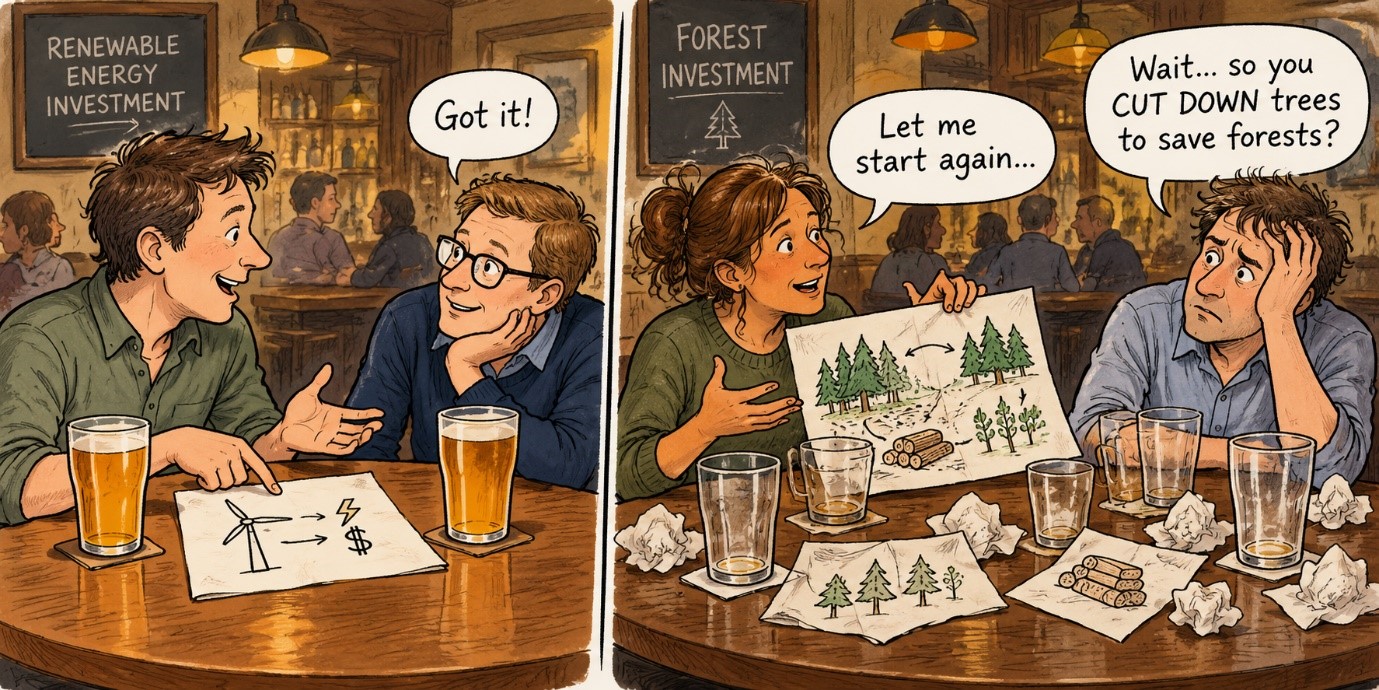
“2 people are at a bar having a conversation about a renewable energy investment – the deal proponent is explaining the concept to the investor, and before they are halfway through their beer – the investor understands it.
Now, 2 people are at a bar having a conversation about a forest investment – the deal proponent is explaining the concept to the investor, and by the time they’ve both fallen down drunk, the investor still doesn’t understand it.”
I regularly struggle to explain the sector to friends and family who are ‘on the outside’. My father-in-law even came to me with a post-it note and said, “Can you explain to me what you do on this post-it note so that I can explain it to others when they ask?”
Impossible.
But why do we struggle?
Why is it always a battle of what is seemingly good (protect the forest) vs evil (harvest timber)?
The narrative for the general public is not changing.
I recently watched the documentary: How to Live on Earth, which has been flooding my LinkedIn feed, and listened to a DOAC short podcast on conservation in the Amazon, and I was left reeling.
Don’t get me wrong – I support the messages that both pieces of mainstream media were promoting. But what ruffled my feathers was the underlying message that the general public will take with them – forest conservation is good, production forestry is bad.
It took me a good half hour lecture with my kids after the film ended to describe why what they saw in the documentary with respect to forest conservation and ‘monoculture’ plantations was only part of the story.
We talked about how managed production forestry can help reduce wildfire severity, how when we live in wooden houses – we’re using renewable materials, and how paper packaging is far less damaging to the environment when compared to petro-chemical based packaging.
We talked about how sustainable forest management can contribute to habitat and therefore wildlife diversity, and how timber plantations can be sustainable alternative to harvesting intact and vulnerable native forests.
We need a simpler narrative. We need to communicate the merits of sustainable forestry, rather than hiding in our small circles and preaching to the choir.
And if you’re raising capital for a forest investment strategy, business or project – this message especially applies to you.
Sure, if you’re talking to investors who already understand the asset class, your conversation will more likely reflect that of the renewable energy example above, but if you’re bringing natural-capital-curious investors into the conversation – you need to be ready to capture their interest and shift the narrative.
Because your investment thesis is competing with everything they think they know about forestry – likely dramatic wildfire headlines, Amazon forest clearing cowboys, and green deserts of timber plantations.
You need to be able to manage a forest sustainably. You need to be able to manage the investment responsibly.
But first – you need to be able to communicate the story.
Communication is the second pillar of the sustainability approach I apply with my clients – after strategy and before documentation and implementation. If you’re currently in this phase and want to sharpen your narrative book a quick call, and we can discuss how your communication can accelerate your capital raise and expand your sustainable forestry footprint faster.
Did you like this article? Sign up now for the ForestLink’s newsletter, where you’ll receive technical advice, reflections, and best-practice guidance to support you with your forest-linked investment strategy or business straight to your inbox.