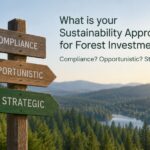
Credible impact or sustainability objectives go beyond pitch deck claims
When you’re in the early days of a new forest investment strategy, it’s easy to get caught up in the name and claims. Trying to communicate to investors in few short words what your strategy is set up to deliver, how you and your strategy are different.
Timberland investing. Forest investing. Natural capital investing. Impact investing. Sustainable investing. ESG investing. Climate investing.
Bioeconomy. Nature positive. Climate positive. Net-Zero. Resilient. Biodiversity enhancement.
The investment industry has created no shortage of labels to describe how capital is being allocated toward forests. While these distinctions are useful, Asset Managers often spend too much time debating definitions and not enough time clarifying their own objectives.
The reality is that there is a place for all these within forest investment, with investors preferring slightly different flavours of sustainable forestry.
Investors who know timberland well, stay for the characteristics of the asset class. Corporate investors may be focused on climate contributions or ensuring the upstream forest resilience of their wood-based value chains. Mission-driven impact investors may have explicit climate, biodiversity, or social objectives and want to demonstrate measurable outcomes alongside financial returns.
None of these motivations are inherently better than another. The key is understanding what you are trying to achieve and ensuring your strategy is designed and communicated accordingly.
Avoid Greenwashing Risk to Secure Investment
Regardless of which label(s) you identify with, there is one challenge facing all forest investment strategies today – Credibility.
As investor interest in forests, and what they expect from them continues to grow, so too does scrutiny. Investors want to understand not only what Asset Managers say they intend to achieve, but whether they can demonstrate meaningful progress against those objectives.
Investors are now expertly aware of greenwashing, and in many cases, greenwashing is not necessarily the result of bad intentions. Sometimes it stems from a lack of clarity around objectives, and misinterpretation of these. In other instances, ambitious claims are made without the management systems needed to support them. A strategy may reference climate, biodiversity, community development, or sustainability outcomes, but if these elements are not actively managed, measured, and reported on – delivery of these outcomes can be questioned, and credibility becomes difficult to maintain.
Building Credibility through Active Management
A well-designed strategy should create a clear line of sight between objectives, management actions, and outcomes.
This requires more than annual reporting. It requires active management, data collection and evaluation of performance.
Performance indicators should be reviewed regularly. Management decisions should be informed by what the data is telling you. Where progress falls short of expectations, there should be mechanisms to adapt and improve.
By now, you know that I’m a proponent of the Theory of Change framework for guiding this process. It is such a simple way to connect strategic ambitions, with aligned actions on the ground, and the mechanisms to evaluate performance. As we increasingly manage forests for more than one financial objective, a streamlined active management approach becomes necessary, and being able to demonstrate this to investors will build clarity, confidence and accelerate your capital raise.
Are you raising capital for forest investment from impact investors – and want a sanity check on how well aligned your strategy is with your objectives, targets and implementation framework? Let’s have a conversation, and see how we can accelerate your capital raise.
Did you like this article? Sign up now for the ForestLink’s newsletter, where you’ll receive technical advice, reflections, and best-practice guidance to support you with your forest-linked investment strategy or business straight to your inbox.